
Kāma means love.
Love for the cup.
Love for the land and the hands behind it.
Love for the rituals that bring it to life.
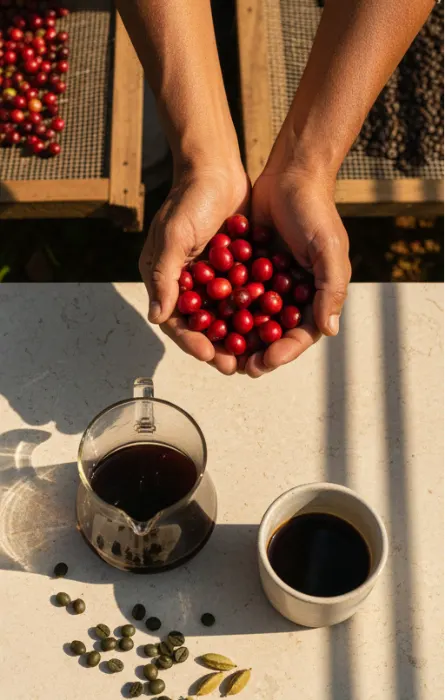
Grown in shade, among trees and spice, Indian coffee offers depth and calm rather than brightness and noise

Our founder
Kāma Coffee was founded by Gayathri Keerthana (GK) in Bristol.
It comes from a simple belief: coffee is not just a product, it is a daily act of care. This brand is her way of building something sensory, trustworthy, and quietly obsessive, one bag at a time.
Kāma Coffee sources from centuries’ old Indian estates where coffee is grown within long-term, shade-based agricultural systems. These farms operate within biodiverse environments, often alongside fruit, spice and native tree cover.
Farming practices are guided by timing, balance, and long-term plant health, not maximum short-term yield. This approach reflects a farming culture where coffee is one part of a broader ecosystem and livelihood, not an extractive crop.
Working with long-established estates provides a stable foundation for consistency, traceability and repeatable flavour year after year.
A distinct Indian coffee flavour
Kāma coffee introduces Indian coffee to the UK through a flavour profile shaped by the unique growing conditions of South Indian coffee landscapes.
Much of India’s Arabica is cultivated at lower altitudes than typical specialty coffee origins. However, these farms are set within dense shade canopies and intercropped landscapes that fundamentally change how coffee cherries develop.
The shade layer moderates temperature swings, protects plants from excessive solar stress, and helps retain moisture in both soil and leaf structure. This allows cherries to mature more gradually, supporting sugar development and bean density despite lower elevation.
Intercropping with fruit and spice trees further stabilises the growing environment, maintaining soil health, supporting water retention and reducing plant stress through natural biodiversity. Consistent access to water from natural sources or monsoon-supported rainfall also contributes to even cherry development.
Seasonal pruning practices play an important role. After harvest, shade branches are often trimmed to increase sunlight penetration, helping prepare the plant for the next growth cycle while supporting controlled drying of cherries during post-harvest stages. This balance between protection during growth and exposure during drying helps build body, sweetness, and layered flavour.
These growing conditions are complemented by controlled honey and semi-washed lots - which further shape Indian coffee’s rounded acidity, greater body, and layered sweetness rather than sharp intensity.
Kāma coffee beans are locally roasted in Bristol in small batches with profiles designed calibrated to highlight these natural qualities — preserving balance, texture, and clarity rather than pushing brightness or roast-driven flavours. Roasting is treated as a careful translation of origin, not an attempt to reshape the coffee into a different style.
The result is a sensory profile centred on warmth, balance, texture, and subtle complexity — cocoa, soft fruit, and gentle spice.
Rituals over rush
In South India, coffee is traditionally consumed at an unhurried pace. Brewed slowly, using a traditional drip filter (usually made of brass or steel), served at home and shared as part of the morning routine, it marks the start of the day as a moment rather than a stimulant.
Kāma Coffee brings this origin-rooted approach into a modern context. We encourage brewing rituals that are flexible, unpressured, and personal — where strength, pace, and method are adjusted for enjoyment rather than output. There is no “correct” way to drink it, only the way that fits your time, taste, and mood.
British tea culture already understands this rhythm: boiling the kettle, waiting, letting the cup cool, drinking when it’s ready. Kāma Coffee builds on that familiar habit, positioning coffee as a thoughtful daily ritual rather than something to rush, chase, or consume for output.
What the profits do
Part of Kāma's profits goes to an India-based non-profit that has spent decades rescuing and rehabilitating people affected by trafficking and abuse, including legal work against abusers. GK ran her own non-profit in rural India years ago, and coffee is her way back into that work. Alongside that, she wants Indian coffee judged on the cup instead of introduced as chai's quieter cousin.
Kāma Coffee is our way of honouring the quiet richness of Indian coffee — and the simple pleasure of drinking it well